
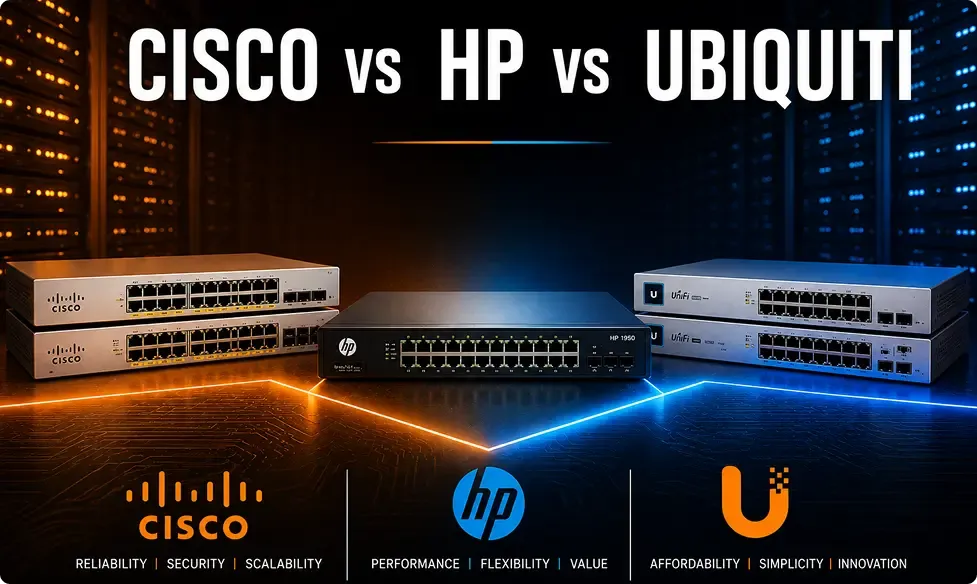
Here’s something most articles skip: when people search “HP switches” they don’t always realize HP’s entire networking line is now sold under HPE Aruba branding. Different name, same lineage — but worth knowing before you start comparing specs. When evaluating Cisco vs HP vs Ubiquiti switches, the right answer genuinely depends on your team size, budget, and whether you have dedicated IT staff on hand. This guide gives you a direct verdict on each, not just a spec dump.
Quick Answer — Which Switch Brand Should You Choose?
When breaking down Cisco vs Aruba vs Ubiquiti, here’s the one-line verdict for each:
- Cisco — If the network is large, complex, and/or compliance-driven (finance, healthcare, government), and enterprise-level support and enhanced security are a must.
- HP (Aruba) — Best for mid-market businesses that want Cisco-like reliability, strong warranty coverage on many models, and lower costs without giving up manageability.
- Ubiquiti — Ideal for lean SMBs with no dedicated IT team that require affordable, easy-to-manage equipment, all in one dashboard.
Cisco Switches — Strengths and Best Fit
Cisco is the standard to which all others are measured — and there’s a reason for that.
It has enterprise-class reliability. Cisco’s advanced features, such as MACsec encryption, advanced QoS, and 24/7 TAC support, make it the solution of choice in environments where downtime matters. Consider hospitals, financial institutions, and government agencies.
The tradeoff? Expensive upfront investments and fees that can quickly start to accumulate, particularly at scale. Many times, you’re paying for a software license when you’re paying for a Cisco switch.
A clever trick: Cisco Catalyst 9200 series or older enterprise-class switches provide you the same enterprise reliability at 40% – 60% off the new list price. It’s the way a growing company can access Cisco infrastructure and not spend a ton of money in year one.
Browse Cisco switches in stock to see what’s currently available.
HP (Aruba) Switches — Strengths and Best Fit
Just to reinforce: if you’re shopping “HP switches,” you’re actually looking at the HPE Aruba product line. The branding shifted, but the reputation for solid, enterprise-adjacent performance stayed.
When doing an HP switch vs cisco switch comparison, the two biggest differentiators are cost and licensing. Aruba skips the per-feature licensing fees that make Cisco expensive to scale. Many HPE Aruba models — including the popular 6200F series — also come with a lifetime limited warranty, which is a genuine differentiator that Cisco doesn’t match at equivalent price points.
Cloud-friendly management, strong VLAN and QoS support, and competitive PoE budgets make Aruba a natural fit for mid-market businesses that need real performance without the Cisco premium.
See HPE Aruba Switches available across multiple tiers.
Ubiquiti Switches — Strengths and Best Fit
Ubiquiti is a different game; not a criticism.
When comparing Ubiquiti vs Cisco switches, aren’t necessarily in terms of quality. It is what you really need. The Ubiquiti UniFi ecosystem allows you to control switches, access points, and cameras from one central console using a no-license-required solution. That’s more important than the intricate details of CLI configuration for a small business owner with five hats on.
The price gap is huge. At similar port counts, UniFi Enterprise switches are available for far less money than Cisco and Aruba.
The truthful compromise: support within the community, rather than a dedicated TAC. It’s noticeable in large deployments or compliance-driven deployments. For those small businesses that do not have a network engineer to manage? I’m an actual big fan of Ubiquiti.
See Ubiquiti Aruba Switches available across multiple tiers.
Cisco vs HP vs Ubiquiti — Side-by-Side Comparison
The best network switch for small business — or an expanding network team — is about matching the right specs to the environment in which they will be deployed. Here’s how these three brands compare across the variables that matter most:
| Feature | Cisco | HP (Aruba) | Ubiquiti |
| Port Density | Up to 48+ ports/chassis | Up to 48+ ports | Up to 48 ports |
| PoE Budget | High (up to 740W+) | High (up to 740W) | Moderate |
| Management Style | CLI + cloud | CLI + cloud | Unified dashboard |
| Typical Price (New) | $$$ | $$ | $ |
| Typical Price (Refurb) | 40–60% off | 35–55% off | 30–50% off |
| Licensing | Required (per feature) | Minimal/none | None |
| Support Model | 24/7 TAC | Business hours + community | Community-based |
| Best Fit | Enterprise/compliance | Mid-market | SMB/lean IT |
If you are considering the addition of expansion modules and SFP uplinks to your switch, and want to know if the uplinks are compatible with the switch you’re considering, it is worth checking before you buy.
Buying Bulk or Refurbished Switches From Any of These Brands
No other comparison article will tell you this: all three brands (Cisco, HPE Aruba, and Ubiquiti) are available refurbished 40 to 70 percent cheaper than new list price. When it comes to purchasing a managed switch for a growing business for expanding your business across multiple locations or floors, the savings really add up at the volume level.
Units are fully tested and receive a written warranty. The per-unit price is also better at 10+, 50+, and 200+ unit order sizes — so a “bundle” quote really does nearly always cost less than pricing the units individually.
If you’re scaling up, request a bulk quote with your full list and get real numbers back.
Frequently Asked Questions
Are HP switches the same as Cisco switches?
No. HP’s networking line, now branded Aruba/HPE, is a completely separate ecosystem. It’s generally priced lower than Cisco and includes a strong lifetime warranty option on many models that Cisco doesn’t offer at comparable price points.
Is Ubiquiti as good as Cisco?
For small businesses without dedicated IT staff, absolutely yes. For large, complex, or compliance-heavy networks — finance, healthcare, government Cisco’s support depth and advanced feature set still lead. It’s less about quality and more about what your environment actually demands.
Can I mix these brands on the same network?
Technically yes, but management gets complicated fast. Keeping your core switching within one ecosystem makes day-to-day operations and troubleshooting significantly easier.
The Bottom Line
Compare the brand to the reality of your budget, size, and IT capability. Cisco for complexity and compliance. Aruba is a mid-market performer with mid-market pricing. Ubiquiti for SMBs with a thin budget. If you’re looking to purchase Cisco switches vs. HP switches vs. Ubiquiti switches, the decision becomes easier after seeing real price comparisons — get a bulk quote on Cisco, HPE Aruba, or Ubiquiti switches and compare what actually fits your budget.