
The processor war is an old battle that sometimes reignites when picking the right processor. If you’re looking at AMD Ryzen 5 vs Intel i7, you’re looking at two completely different value propositions.
It isn’t easy to compare these two families. AMD Ryzen 5 VS Intel i7 is a match-up of middle-of-the-road performance versus top-of-the-line performance. Both silicon families cover multiple generations of systems from older DDR4 silicon to newer DDR5 and PCIe 5.0 silicon. When evaluating the performance of both the i3 and i7 processor families, the number of cores, architecture, and overall usefulness in real-world use are all important to consider between generations.
Here’s the processor tier guide to help you determine which processor has better gaming performance, video rendering performance, multitasking performance, and value for money in the long run.
Ryzen 5 vs Intel i7: Understanding Both CPU Families
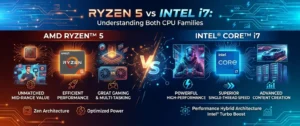
It is important to know how these silicon manufacturers are breaking up their silicon before investing. AMD’s Ryzen 5 family is pitched squarely in the mid-range, designed to appeal to those who are generally using devices for their day-to-day needs, competitive gamers, and productivity users in the mainstream market who don’t mind paying enthusiasts’ prices.
Intel pushes the Core i7 segment above the Core i5, next to its top-of-the-range i9 segment. This means that the Intel Core i7 vs AMD Ryzen 5 comparison is between a high-performance chip and a mainstream efficiency chip.
- AMD Ryzen 5 Pricing & Target: Prices may be $180–$240. It is designed for the mainstream gamer, remote worker, student, and budget-conscious PC builders.
- Intel Core i7 Price: The price of the Intel Core i7 ranges from $300 to $420. For heavy content producers, software developers, 4K video editors, and power gamers.
- Desktop vs. Laptop Form Factors: On the desktop, the Ryzen 5 is a more straightforward pure-core set, while the Intel i7 is a hybrid. With mobile platforms, laptop manufacturers tend to play a lot with voltage and thermal limits, so thermals and battery efficiency are very much a factor when it comes to choosing between the two.
AMD Ryzen 5 Processors Explained
The Ryzen 5 series is known to be the benchmark for midrange PC makers in terms of performance-to-price ratio. Most of the Ryzen 5 desktops based on AMD’s modular chiplet architecture (Zen 4, Zen 5) have 6 physical cores and 12 threads.
All 6 cores are full-performance cores, so Ryzen 5 chips will continue to execute instructions at the same rate even if they aren’t running background software.
The key features of the AMD Ryzen 5 lineup are:
- The number of Cores / Threads is 6 / 12 (SMT).
- Optimized Power Efficiency: Most of the models have lower-than-average TDP (Thermal Design Power), reducing electricity costs and heat generation.
- AM5 motherboards have integrated graphics for desktop use, with a few that are “G-series” having powerful built-in GPUs for budget gaming.
- Ryzen AI Processors: Ryzen AI is a dedicated feature of AI chips that are built into some Ryzen mobile and desktop processors to speed up local AI workloads by using Neural Processing Units (NPUs) with XDNA architecture.
- Best use cases: 1080p and 1440p gaming rigs, general multitasking, office productivity, and budget-friendly home builds.
Intel Core i7 Processors Explained
Intel’s Core i7 family is designed for users who require heavy multi-threaded processing power and top-tier single-core clock speeds. Starting with the 12th Gen Alder Lake architecture and extending through 14th Gen and Core Ultra 200S series, Intel adopted a hybrid architecture. This design splits processing tasks between high-speed Performance-cores (P-cores) and energy-efficient Efficient-cores (E-cores).
Key features of the Intel Core i7 lineup include:
- Hybrid Architecture: Combines heavy-lifting P-cores with background-handling E-cores for high total core and thread counts.
- High Turbo Frequencies: Frequently pushes clock speeds up to 5.6 GHz or higher right out of the box for snappy single-threaded execution.
- Integrated Graphics: Includes Intel UHD or Arc-based integrated graphics featuring QuickSync video encoding hardware, which speeds up video rendering pipelines.
- Advanced Memory Support: Supports both DDR4 and DDR5 memory across 12th, 13th, and 14th generations, giving builders flexible system component options.
- Best Use Cases: 4K video editing, heavy 3D rendering, compiling massive code bases, hosting virtual machines, and high-frame-rate streaming.
AMD Ryzen 5 vs Intel i7: Key Differences
To understand how AMD Ryzen 5 vs Intel Core i7 processors stack up across hardware specifications, platform features, and real-world capabilities, we have summarized their primary hardware specifications below.
The table below breaks down the technical baseline comparing modern desktop iterations of both processor lines.
| Feature / Specification | AMD Ryzen 5 (e.g., 9600X / 7600X) | Intel Core i7 (e.g., 14700K / 13700K) | Advantage Winner |
|---|---|---|---|
| Core Count | 6 Cores (All Full-Performance) | Up to 20 Cores (8 P-Cores + 12 E-Cores) | Intel i7 |
| Thread Count | 12 Threads | Up to 28 Threads | Intel i7 |
| Architecture Design | Chiplet-based (Zen 4 / Zen 5) | Monolithic / Hybrid Architecture | Tie |
| Max Boost Clock Speed | 5.3 GHz – 5.4 GHz | 5.4 GHz – 5.6 GHz | Intel i7 (Slight) |
| L3 Cache Size | 32 MB | 30 MB – 33 MB | Tie |
| Power Consumption (TDP) | 65W Base (88W Peak Package Power) | 125W Base (253W Peak Package Power) | AMD Ryzen 5 |
| Integrated Graphics | RDNA 2 iGPU (Basic Display) | Intel UHD 770 / Arc (QuickSync) | Intel i7 |
| Platform Socket | AM5 Platform | LGA 1700 Platform | AMD Ryzen 5 |
| Platform Upgrade Path | Supported through 2027+ | End-of-life platform (LGA 1700) | AMD Ryzen 5 |
| Average Retail Price | $180 – $240 | $350 – $400 | AMD Ryzen 5 |
In summary, Intel has the higher number of cores and threads, translating to a greater total compute bandwidth. But the platform longevity, thermal management, energy efficiency, and total purchase value are the areas where AMD is a leader.
Ryzen 5 vs Intel Core i7: Generation-by-Generation Comparison
Comparing AMD Ryzen 5 vs Intel i7 across the same generation of processors gives a clear performance context, as buyers tend to consider a wider range of product generations or even previous-generation hardware at a lower price.
Ryzen 7000 vs Intel 14th Gen
When pitting the Zen 4-powered Ryzen 5 7600X against Intel’s Core i7-14700K, the two are facing two different price tiers. The 14700K’s 20 cores are all total. That’s a huge benefit in multi-threaded applications such as Cinebench, Premiere Pro and Blender.
When it comes to pure gaming, though, in 1080p the i7 carries the day against the Ryzen 5 7600X, but at a significantly reduced power usage and CPU price.
The table below shows AMD’s Zen four mainstream chip’s performance in comparison to Intel’s 14th Gen i7.
| Processor Spec | AMD Ryzen 5 7600X | Intel Core i7-14700K |
|---|---|---|
| Cores / Threads | 6C / 12T | 20C (8P + 12E) / 28T |
| Boost Clock | 5.3 GHz | 5.6 GHz |
| Base TDP | 105W | 125W |
| Memory Support | DDR5 Only | DDR4 & DDR5 |
| Socket | AM5 | LGA 1700 |
Ryzen 7000 vs Intel 13th Gen
The Ryzen 5 7600 matches up cleanly against Intel’s Core i7-13700K. The i7-13700K features 16 cores (8 Performance + 8 Efficiency) and 24 threads. For raw multithreaded rendering, Intel wins comfortably.
For gaming, single-core IPC enhancements in AMD’s Zen 4 architecture keep the Ryzen 5 7600 highly competitive, framed by its low 65W thermal profile.
The table below breaks down the specs for Zen 4 vs 13th Gen Intel i7.
| Processor Spec | AMD Ryzen 5 7600 | Intel Core i7-13700K |
|---|---|---|
| Cores / Threads | 6C / 12T | 16C (8P + 8E) / 24T |
| Boost Clock | 5.1 GHz | 5.4 GHz |
| Base TDP | 65W | 125W |
| Platform Support | AM5 (DDR5) | LGA 1700 (DDR4/DDR5) |
Ryzen 5000 vs Intel 12th Gen
The low-cost Ryzen 5 5600X is a competitor to Intel’s 12th Gen Core i7-12700K. The Ryzen 5 5600X is a well-liked budget gaming processor that’s based on the well-established AM4 platform.
The 12700K is the first processor to feature Intel’s hybrid architecture (12 cores / 20 threads); however, it performs significantly better in multitasking, video production, and intensive workstation applications compared to the 5600X.
The following table describes the budget platform comparison of AM4 to LGA 1700.
| Processor Spec | AMD Ryzen 5 5600X | Intel Core i7-12700K |
|---|---|---|
| Cores / Threads | 6C / 12T | 12C (8P + 4E) / 20T |
| Architecture | Zen 3 | Alder Lake (Hybrid) |
| Max Boost | 4.6 GHz | 5.0 GHz |
| RAM Compatibility | DDR4 | DDR4 & DDR5 |
Ryzen 3000 vs Intel 11th Gen
Comparing the older Ryzen 5 3600 against Intel’s Core i7-11700K shows how much CPU architectures have evolved. The 11700K (Rocket Lake) offers 8 full-performance cores and 16 threads, beating the older Zen 2-based Ryzen 5 3600 in both gaming and productivity.
However, the 11700K ran hot and consumed high amounts of power, while the Ryzen 5 3600 remains one of the most efficient budget drop-in upgrades for older AM4 motherboards.
The table below contrasts these legacy processors.
| Processor Spec | AMD Ryzen 5 3600 | Intel Core i7-11700K |
|---|---|---|
| Cores / Threads | 6C / 12T | 8C / 16T |
| Process Node | 7nm TSMC | 14nm Intel |
| Power Draw | 65W | 125W (PL2 251W) |
Gaming Performance Comparison
If you’re on a budget, the AMD Ryzen 5 can give you almost the same 1080p and 1440p gaming performance as the Intel Core i7 at a much smaller price tag. The price difference means that for a higher frame rate, the Ryzen 5 builder can afford to pay more for a more powerful graphics card, but in CPU-intensive esports titles, the i7 might be marginally more capable.
Modern game engines have a strong reliance on single-thread clock speed, instruction-per-clock (IPC) efficiency, and cache latency. When evaluating an Intel i7 vs AMD Ryzen 5 system for gaming, resolution plays a huge role:
- 1080p Gaming: With 1080p comes the processor and its maximum frame rate capabilities. The slight competitive advantage in titles such as CS2, Valorant, and Rainbow Six Siege belongs to the Intel i7 processors, which feature higher boost clocks than the other chips.
- With higher resolutions, you’re in the GPU-bound range of 1440p & 4K Gaming. With GPUs such as an RTX 4070 or RX 7800 XT, the difference between the Ryzen 5 and Intel i7 is vast, effectively closing up on average FPS.
- Esports vs. AAA Titles: Esports games still take advantage of Intel’s high frequencies on its single cores. AAA open-world games (Cyberpunk 2077 and Starfield) play well on the 6 cores of the Ryzen 5, with Intel’s additional cores giving a tiny advantage in terms of 1% low frame rate stability when loading up physics scenes.
The table below reflects roughly how fast the average frame rate should be in the most common setups for games.
| Resolution / Genre | AMD Ryzen 5 + Mid-Range GPU | Intel Core i7 + Mid-Range GPU | Performance Leader |
|---|---|---|---|
| 1080p Competitive Esports | ~340 FPS | ~365 FPS | Intel Core i7 (Minor Lead) |
| 1080p AAA Open World | ~115 FPS | ~122 FPS | Intel Core i7 (Slight Lead) |
| 1440p Ultra Settings | ~98 FPS | ~100 FPS | Tie (GPU Bound) |
| 4K Gaming | ~62 FPS | ~62 FPS | Tie (GPU Bound) |
Productivity Performance Comparison
If you want to use your computer for multi-threaded productivity tasks such as creating 4K videos, building 3D models, or compiling software, you’ll find Intel Core i7 significantly superior. With its improved core count up to 20 cores, it can power through heavy workloads with efficiency, which is beneficial for professional creators who can save significant time with the better performance.
Both processor levels are fairly close on games, but heavy productivity tasks are very clear. Whether it’s for gaming, content creation, or various other power-intensive applications, Intel’s Core i7 processor with its maximum of 20 cores means they have a significant multi-threading edge over the 6-core Ryzen 5 processors.
- Video Editing & Streaming: Intel i7 processors dominate in Adobe Premiere Pro and DaVinci Resolve. The integrated Intel QuickSync encoder accelerates hardware timeline scrubbing and video export times.
- 3D Rendering & CAD: 3D applications such as Blender, V-Ray and Cinema 4D grow linearly with the number of cores. The i7 is up to 40% faster than the Ryzen 5 when it comes to multi-core CPU performance.
- Programming & Virtual Machines: For running multiple Docker containers, compiling code, or for a virtual machine, multiple cores and 24 to 28 threads have a direct impact.
- Multitasking: Ryzen 5 will manage common multitasking scenarios without any complaint, being able to carry dozens of tabs in a browser, office suites, and background music. But Intel’s additional Efficiency cores aren’t stealing power from foreground applications.
The table below illustrates multi-threaded productivity scaling across key workstation workloads.
| Workload Category | AMD Ryzen 5 Capability | Intel Core i7 Capability | Category Winner |
|---|---|---|---|
| 4K Video Rendering | Good for casual editing | Professional-grade speed | Intel Core i7 |
| 3D Modeling & Animation | Suitable for basic assets | High throughput rendering | Intel Core i7 |
| Software Development | Fast single-thread builds | Rapid multi-threaded builds | Intel Core i7 |
| Photo & Vector Editing | Highly responsive | Highly responsive | Tie |
Power Efficiency & Thermals
Energy use and thermal performance are two areas where AMD has an apparent engineering edge. With its cutting-edge process nodes, AMD Ryzen 5 delivers high computing performance in low power envelopes.
- Thermal Design Power (TDP): Desktop Ryzen 5 chips have a 65W base TDP rating (with a peak of about 88W when under heavy load). Intel i7 chips have a base TDP of 125W, but consume 220W to 253W when running under full multi-core load.
- Cooling Requirements: Under heavy usage, a single-tower $20-$30 120V air cooler is all that is required to keep the Ryzen 5 cool and quiet. Under sustained heavy workloads, you should use a high-end dual-tower air cooler or a 240mm/360mm All-In-One (AIO) liquid cooler to avoid thermal throttling with an Intel i7.
- Laptop Battery Life: On mobile platforms, Ryzen 5 laptops generally draw less power during light workloads and video playback, providing longer battery runtimes. Intel i7 laptops offer high short-burst performance, but can run hotter and drain batteries faster under heavy processing tasks.
For more information on maintaining CPU temperatures, see our guide on how long thermal paste lasts and when it should be replaced.
Ryzen AI 5 vs Intel i7
The transition from cloud servers to consumer processors for integrating AI has begun. The first thing to consider when comparing AMD Ryzen AI 5 to an Intel i7 system is the integrated Neural Processing Units (NPUs).
In order to emphasize the dedicated XDNA NPU hardware blocks in a processor, AMD has adopted the Ryzen AI branding. These dedicated AI accelerators take over the local AI workloads, currently offloaded to the CPU and GPU, including:
- Real-time background blurring and eye-contact correction when doing video calls.
- Private deployment of localised Large Language Models (LLMs) and AI coding assistants.
- Speeds up audio noise cancellation and image editing filters with AI.
- Intel is also competing with AI features on its mobile lineup of Core Ultra processors with baked-in NPUs.
For regular users, an NPU can be beneficial for conserving battery life, as it can process AI functions without using the battery-intensive primary CPU cores. When you need to depend on Windows Studio Effects, local generative AI solutions, or real-time voice processing, the choice of AI-enabled Ryzen AI 5 and Intel processors becomes evident as they offer a clear path toward future software support.
Modern games like GTA 6 require powerful hardware to deliver smooth performance. Check out our GTA 6 system requirements guide to learn about the expected CPU, GPU, RAM, and storage requirements for the game.
Which CPU Should You Buy?
To make your decision easier, here are clear purchasing recommendations tailored to specific budget levels, use cases, and performance priorities.
Best for Gaming
Buy AMD Ryzen 5.
For video games, the Ryzen 5 will produce almost the same frame rates as an i7. That $150-$200 saved in the CPU can go right into the purchase of a better-level graphics card and result in a more powerful gaming system in total.
Best for Productivity
Buy Intel Core i7.
The Core i7’s higher core and thread count will make money for you if you’re earning a living as a video editor, 3D animator, software compiler, or virtual machine operator.
Best Budget Build
Buy AMD Ryzen 5.
The lower overall price of AMD’s chips, the affordable cooling requirements, and the price of their motherboards make the Ryzen 5 series the perfect base for a budget PC.
Best Laptop
Buy AMD Ryzen 5 for Battery Life; Intel i7 for Raw Mobile Power.
If you’re looking for long battery life, cooler laptop thermals, and portability, select a Ryzen 5 laptop. Consider the Intel Core i7 processors if you require the power of a CPU on your workstation and will need to be plugged in anywhere.
Best Future Upgrade
Buy AMD Ryzen 5 (AM5 Platform).
AMD’s AM5 socket will see motherboard support until 2027 and even beyond. This way you can install a Ryzen 5 today, and swap out for the next generation of upgrade years later without having to purchase a new motherboard.
Best Overall Value
AMD Ryzen 5.
The Ryzen 5 is the ideal choice for 80% of the user base, gamers included, due to its sweet-spot compromise between power consumption, system thermals, real-world responsiveness, and price.
While choosing a CPU is important, your graphics card also plays a major role in gaming performance. Explore our GTX 1080 Ti in 2026 guide to see its current gaming performance, benchmarks, and whether it is still worth using
Step-by-Step Decision Checklist
If you need energy efficiency, reduced hardware expenses, budget gaming, and/or a future-proof motherboard platform, then buy AMD Ryzen. If you are going to use the most demanding professional workstation software, heavy video rendering pipelines, or the highest single-thread boost clock speed, then buy Intel.
Follow this quick step-by-step checklist to select the perfect processor for your next build or laptop purchase:
- Sort out your Main Task: If it is for general office and gaming work, you should choose Ryzen 5; if it is for professional content creation and multi-threading work, you should choose Intel i7.
- Use Ryzen 5 when the total hardware budget is less than $1,200.00: When you have a budget of less than $1,200.00, then you should choose Ryzen 5 and spend more on the graphics or video card. If you have a budget above $1,500, an Intel i7 will be a great choice.
- Look at Motherboard Upgrade Plans: If you’re thinking about upgrading your CPU in 3-4 years, but will be keeping the same motherboard, then you should look at those plans. Choose AMD AM5.
- Evaluate Thermal and Cooling Constraints: Building in a compact Small Form Factor (SFF) case or want a whisper-quiet PC? Choose Ryzen 5.
Common Questions Related to AMD Ryzen 5 vs Intel Core i7
Which is better, Ryzen or Intel?
Neither brand is universally better across all categories. AMD Ryzen typically leads in power efficiency, gaming performance per dollar, and long-term motherboard upgrade support. Intel leads in multi-threaded productivity tasks, heavy content creation workflows, and integrated media encoding technology.
Is the Ryzen 5 better than the i7?
For budget gaming and everyday efficiency, Ryzen 5 is often the better purchase because it delivers comparable gaming frame rates at a much lower cost. However, for multi-threaded creative applications like 3D rendering and 4K video editing, the Intel Core i7 is significantly faster due to its higher core count.
What is AMD Ryzen 5 compared to Intel?
In terms of market positioning, AMD Ryzen 5 is equivalent to Intel Core i5. Compared to an Intel Core i7, the Ryzen 5 is available at a lower price point and is quite competitive in single-core applications and gaming performance, with the added benefit of consuming less power.
Is Ryzen better than Intel?
Ryzen is superior in terms of platform longevity, easy cooling requirements, reduced thermal output, and best value for gaming builds. Intel is better if you need the maximum amount of multi-core processing power for heavy workstation applications.
What is the difference between Intel i5 and AMD Ryzen 5 processor?
They both position themselves squarely in the middle range as options for mass producers. The Intel i5 processors are hybrid in design: Performance + Efficiency cores, while the desktop AMD Ryzen 5 processors have 6 high-performance cores. Both are terrific for gaming and productivity for the price.
Is Ryzen 5 good for a laptop?
Yes, Ryzen 5 is a great option to buy for laptops. It delivers exceptional battery life, minimal heat, and performance that’s great for day-to-day multitasking, office productivity, light content creation, and casual gaming.
Which is better, Intel or Ryzen for laptops?
In general, AMD Ryzen laptops are more likely to provide longer battery life and improved thermal performance when they’re not plugged in. Intel laptops are great when it comes to plug-and-play performance, intensive content creation applications, and fast connectivity options like Thunderbolt and Wi-Fi 7.
Which is faster: Ryzen 5 vs i7?
Intel Core i7 excels in applications requiring significant multi-core power, such as video creation, compression, and 3D modeling. In single-core application response and game frame rate, however, both processors are extremely close in performance.
Final Words
Comparing AMD Ryzen 5 vs Intel i7 is all about comparing the strengths of the processors with the needs of the users. Best-in-class multi-core productivity, heavy video editing, and complex multi-threaded workloads belong to the Intel Core i7. In the meantime, the AMD Ryzen 5 claims gaming value, power efficiency, cooler operating temps, and platform upgradeability. Determine the main workloads and overall system budget to select the appropriate CPU.