
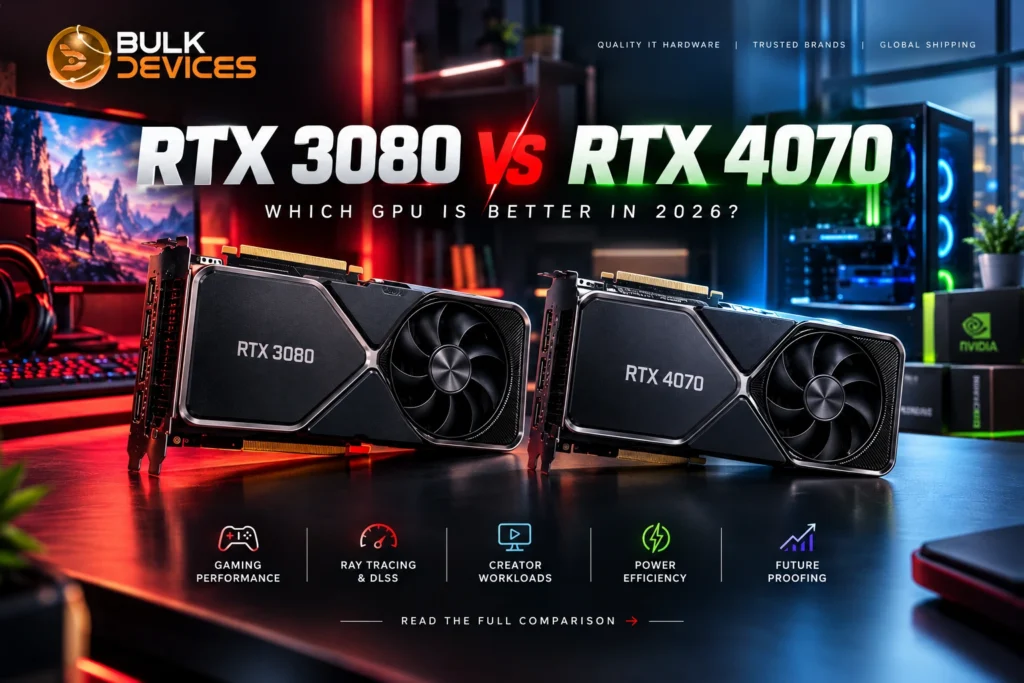
RTX 3080 vs 4070 is one of the greatest GPU comparisons of all time, and it’s for a perfectly good reason. Nvidia’s flagship a few years ago, the RTX 3080, is still in use by many gamers. In 2026, that’s what is more important than it was at launch time: at the same time, the RTX 4070 introduces a new architecture, improved efficiency, DLSS 3, and AV1 encoding. You’ll find authentic answers to questions about gaming performance, creator workloads, ray tracing, power efficiency, future proofing, and if it’s even worth it to you to upgrade. No ‘fluff’, just a straightforward buying guide.
Quick Verdict
Choose RTX 4070 if:
- Lower power consumption & quieter thermals are desired
- You are concerned about DLSS 3, Frame Generation, and AV1 encoding
- You need to provide increased long-term driver support in a new system.
Choose RTX 3080 if:
- One of these: you can get it at a reduced price
- You would like to use more raw memory bandwidth for some jobs.
- You already have one and primarily play at 1440p.
Best Overall: RTX 4070
Best Value: Used RTX 3080
Best for 4K: RTX 3080 (with caveats)
Best for AI: RTX 4070
Specifications
On the surface, these two cards seem to be going in opposite directions in terms of performance. Both the RTX 3080 and RTX 4070 are equipped with thousands of cores, but the latter’s clock speeds are smarter than the former’s, and it comes with a wider memory bus that still requires much less power.
| Spec | RTX 3080 | RTX 4070 |
|---|---|---|
| Architecture | Ampere (8nm) | Ada Lovelace (5nm) |
| CUDA Cores | 8,704 | 5,888 |
| Boost Clock | ~1.71 GHz | ~2.48 GHz |
| VRAM | 10GB GDDR6X | 12GB GDDR6X |
| Memory Bus | 320-bit | 192-bit |
| Bandwidth | ~760 GB/s | ~504 GB/s |
| Tensor Cores | 3rd Gen | 4th Gen |
| RT Cores | 2nd Gen | 3rd Gen |
| Power Draw (TDP) | 320W | 200W |
| PCIe | 4.0 | 4.0 |
| DLSS Support | DLSS 2 | DLSS 3 (Frame Generation) |
| AV1 Encoder | No | Yes |
| Launch Year | 2020 | 2023 |
Who wins what: the RTX 3080 still wins by raw cores and memory bandwidth, but the RTX 4070 wins on VRAM, efficiency, clock speed, and all features that impact today’s games and AI programs. In 2026, most purchasers are more interested in features and efficiency than a bandwidth number on a spec sheet.
Gaming Performance Comparison
Numbers on a spec sheet only represent half of the story: actual RTX 3080 vs RTX 4070 gaming performance is far more resolution- and DLSS-dependent.
1080p Gaming
Both cards are more than powerful at 1080p, and you will likely see CPU limitations before GPU limitations. Fortnite, Warzone, and Forza Horizon 5 are some of the titles in which both GPUs achieve 144+ FPS at high settings. Ada’s architecture and cache design shine in newer, more demanding games, as the RTX 4070 gaming performance is primarily evident in such titles.
1440p Gaming
It’s the place that is perfect for both cards, and it’s where the similarity becomes quite close. In Spider-Man Remastered and Red Dead Redemption 2, the two engage in some sparring in just a few frames. When it comes to Cyberpunk 2077 or Alan Wake 2, though, the RTX 4070 delivers a boost due to its more recent RT cores and DLSS 3 Frame Generation, which can boost the perceived frame rate by nearly half.
4K Gaming
In games that demand the most VRAM bandwidth, like Starfield, the RTX 3080’s extra VRAM bandwidth keeps it competitive in native-resolution games. On the downside, without DLSS 3, the 3080 doesn’t perform well in ray-traced titles. Despite the lower raw power numbers, the RTX 4070 is helping to provide a smoother 4K experience overall thanks to the implementation of DLSS 3 Quality mode.
| Game | RTX 3080 (1440p Avg FPS) | RTX 4070 (1440p Avg FPS) |
|---|---|---|
| Cyberpunk 2077 (RT) | 48 | 65 (with DLSS 3) |
| Alan Wake 2 (RT) | 38 | 58 (with DLSS 3) |
| Starfield | 62 | 64 |
| Warzone | 110 | 115 |
| Fortnite | 135 | 142 |
| Red Dead Redemption 2 | 88 | 90 |
| Forza Horizon 5 | 105 | 112 |
| Spider-Man Remastered | 95 | 98 |
In short, the two cards are neck-and-neck when it comes to performance without DLSS 3. As long as ray-traced and CPU-limited scenes are concerned, the RTX 4070 is clearly in front in both instances with DLSS 3 and Frame Generation enabled.
If you’re experiencing higher GPU temperatures over time, our guide on how long thermal paste lasts explains when replacing the paste may help.
Ray Tracing, DLSS & Frame Generation
So here is where the generation gap is really evident. Both of these cards have the ability to support DLSS 2, which uses AI to improve performance by enhancing lower resolution frames. For gamers with DLSS 3, the feature is only available on the RTX 4070 and later cards, providing a new feature called Frame Generation, which places completely new AI-generated frames that serve as buffers between two frames that have been rendered. This can almost double the framerate in supported games, but is optimally used in games that have a moderately high frame rate.
The DLSS 3.5 update also introduces new Ray Reconstruction to enhance denoising in ray-traced scenes, and it performs significantly better on the newer RT cores of the 4070.
The RTX 4070’s 3rd generation RT cores process reflections, shadows, and global illumination at higher efficiency, even when compared to the 3080’s 2nd generation RT cores.RT performance is on the whole much better on the RTX 4070, because the 3rd generation of RT cores is more efficient at processing reflections, shadows, and global illumination — and can do so with fewer total cores than the 3080.
The RTX 4070 additionally has an AV1 encoder, also significant for streamers or content creators streaming on platforms that support the newer, more efficient codec. But in the future, most games currently in development will be created with DLSS 3 and Frame Generation in mind, thus making the 4070 the direction of the future for game support.
Creator & AI Performance
Creators have to pick their software, depending on the software choice. The RTX 4070’s architecture and improved ray-tracing hardware more than compensate for its reduced CUDA core count in Blender, resulting in faster rendering speeds in general. Both cards are equally effective at editing and color grading in Premiere Pro and DaVinci Resolve; however, having the AV1 encoder on the 4070 card really helps when exporting or streaming projects.
In terms of pure batch size and generation number, VRAM is more critical than cores for Stable Diffusion and local AI image generation, making the RTX 4070’s 12GB capacity more advantageous than the 3080’s 10GB in the latter instances. The 4070 is typically more efficient per watt, so it is the better choice when rendering for long periods of time. Unless they are doing work that takes more advantage of the card’s cores, CUDA workloads will prefer to use whichever card has more cores for the specific job. The AV1 encoder on the 4070 also decreases CPU usage and improves stream quality at lower bitrates than the 3080’s H.264/HEVC-only encoder for streaming.
So which GPU is better for creators? The RTX 4070 is a more practical option for most modern workflows, such as video export, AI-assisted editing, and streaming. The RTX 3080 remains competitive in basic rendering workloads, where CUDA core count is a key factor.
Power Efficiency, Thermals & Noise
One of the largest practical differences between the two of these cards is this. The RTX 4070 is a beefy card that uses up to 200W, compared to the RTX 3080’s consumption of up to 320W — the power difference is significant when playing or rendering for extended periods.
| Category | RTX 3080 | RTX 4070 |
|---|---|---|
| Power Draw | 320W | 200W |
| Recommended PSU | 750W | 650W |
| Load Temperature | ~72–78°C | ~65–70°C |
| Cooling Needs | Higher | Moderate |
| Noise Under Load | Louder | Quieter |
| Est. Electricity Cost (5 hrs/day) | Higher | ~35% lower |
This reduces power usage, which makes the RTX 4070 cooler, easier to cool, and quieter when it is put to the test. Playing the same number of games in a year won’t make much difference to the electricity bill per game, but will make a big difference when you add it up, especially in areas that have high electricity costs.
RTX 3080 vs RTX 4070 for Machine Learning & AI Workloads
AI and machine learning workloads have different requirements than gaming, and the RTX 4070 has some advantages beyond just VRAM. It is much more efficient at processing FP16 and mixed-precision workloads, resulting in faster training of models and inference in frameworks such as PyTorch and TensorFlow.
VRAM capacity is typically the constraint that comes before raw compute for local AI tools (Ollama, ComfyUI, Automatic1111, and local LLMs such as Llama, Mistral, DeepSeek). The 4070’s 12GB of RAM provides a bit of breathing space over the 10GB of the 3080, allowing you to run a bit larger model or context windows before you reach out-of-memory issues. Both cards are not preferable to 16GB+ cards for serious local LLM work, but the 4070 is preferable between the two.
Both cards are decent at Stable Diffusion and AI imagery generation; however, the 4070 generates images quicker per watt and is more forgiving with larger batch sizes, due to the VRAM and newer Tensor Core architecture. The local AI coding assistants are also more VRAM-intensive than a simple CUDA tally; in this case, the 4070 benefits more.
Inference (running a trained model) is much less demanding than training, and both GPUs are reasonably good for inference workloads. The 4070, on the other hand, has more VRAM and Tensor Core throughput, which can help when training your own models, and does better than the other cores at that job. One definite thing is that the 200W TDP will be retained in the 4070 over the 320W TDP of the RTX 3080 series over long AI workloads.
| Category | RTX 3080 | RTX 4070 |
|---|---|---|
| CUDA Cores | 8,704 | 5,888 |
| Tensor Cores | 3rd Gen | 4th Gen |
| VRAM | 10GB | 12GB |
| Memory Bandwidth | 760 GB/s | 504 GB/s |
| Stable Diffusion | Good | Better |
| LLM Performance | Limited by VRAM | Slightly better VRAM headroom |
| PyTorch | Strong | Strong, more efficient |
| TensorFlow | Strong | Strong, more efficient |
| Best AI Use Case | Budget training tasks | Local inference & image gen |
Best GPU for AI beginners: RTX 4070, for easier setup and lower power costs. Best for local LLMs: RTX 4070, thanks to slightly more VRAM. Best for Stable Diffusion: RTX 4070. Best overall value for machine learning: a used RTX 3080, if you can find one cheap and don’t mind the higher power bill.
RTX 3080 vs RTX 4070 for GTA 6
It’s one of the most popular inquiries about this comparison, but we’ll be honest: Rockstar doesn’t have PC system requirements for GTA 6, and as of mid-2026, there’s no confirmation of a PC version. All under is based on “expected” performance, not official specs.
With the PC port coming in GTA 6, both of the two GPUs should be able to do the job at high settings at 1080p, if Rockstar’s RAGE 9 engine scales at a similar rate as Red Dead Redemption 2. If GTA 6 heavily relies on ray tracing, as early gameplay also indicates. If GTA 6 is indeed a heavy ray-traced game, as early trailers suggest, then the RTX 4070’s DLSS 3 support is a clear benefit. Neither of these cards will be able to reach ultra settings natively at 4K and will likely need to use DLSS Quality mode or Frame Generation to get a smooth experience, which will go towards the 4070.
Ray tracing is expected to be “very high” with GTA 6, a scene where Rockstar’s marketing efforts have focused on lighting and reflections, the areas where the RTX 4070 shines. But VRAM considerations are important too — Rockstar’s open worlds tend to consume a lot of VRAM, and the additional 2GB may help make it a bit more future-proof for new content and DLC.
| Feature | RTX 3080 | RTX 4070 |
|---|---|---|
| Expected 1080p | High settings, 60+ FPS | High settings, 60+ FPS |
| Expected 1440p | Medium-High, ~50 FPS | High with DLSS, 60+ FPS |
| Expected 4K | Struggles without upscaling | Playable with DLSS 3 |
| Ray Tracing | Limited headroom | Better suited |
| DLSS Support | DLSS 2 only | DLSS 3 with Frame Gen |
| Frame Generation | No | Yes |
| Future-Proofing | Lower | Higher |
Practical advice: If you’re primarily focused on using the PC for GTA 6, the RTX 4070 is likely to be a superior long-term investment because it has DLSS 3 and Frame Generation support, which will likely be significant for a game that features a lot of ray tracing. Some players may prefer to get a used RTX 3080, while a new RTX 4070 makes more sense for those wanting to experience the game at its best quality and performance when it finally arrives on PC.
Planning to play GTA 6? Check our GTA 6 system requirements guide to see what hardware you’ll need.
Should You Upgrade from RTX 3080 to RTX 4070?
This depends solely upon what you currently do with your PC. If you’re only gaming at 1080p, your money is better spent elsewhere since both cards handle 1080p fine and you don’t really need to upgrade. DLSS 3 is expected to make a significant impact for ray-traced titles for 1440p users, but not so much for casual 1440p players.
For 4K users, the most obvious advantage of the RTX 4070’s DLSS 3 capabilities is that 4K without upscaling is very challenging for both cards in demanding titles. If you’re conscious of Frame Generation, you should upgrade if you’re using a DLSS card, as the option is only available on the 4070 and newer models. Competitive gamers focused on high refresh rates at 1080p or 1440p likely won’t see enough of a difference to justify the cost — their bottleneck is usually the CPU anyway.
The AV1 encoder and improved efficiency will benefit content creators who are involved in video export, AI-assisted workflows, or streaming. If you already have an RTX 3080 and it is sufficient for your requirements, then there is no pressing need to upgrade. However, if you’re developing new games or your 3080 is having trouble with newer ray-traced games, the 4070 is the better option to choose.
Used RTX 3080 vs New RTX 4070
It’s one of the greatest differences in this entire comparison, and is worthy of careful consideration. The used RTX 3080 may be available for much cheaper than the new RTX 4070, so it’s easy to be tempted by the price. However, there are genuine risks.
Availability: It should compare a used 3080 to a new 4070, making the 3080 the more budget-friendly option upfront. Warranty & Longevity: A new RTX 4070 comes with full manufacturer warranty coverage, while a used RTX 3080 usually has little to no warranty left and an unknown usage history — making it a riskier long-term buy. Mining risk: The RTX 3080 has been a popular choice for cryptocurrency mining during the crypto mining craze, which means that a used unit might be worn out despite its apparent appearance.
Driver support currently covers both cards, but Nvidia’s optimization focus tends to shift toward newer architectures over time, meaning the 4070 will likely receive better-tuned drivers for longer. Resale value also favors the 4070, since it’s newer and more efficient, making it easier to sell down the line. Future support for new features and game optimizations will lean toward Ada Lovelace and newer architectures as time goes on.
In conclusion, purchasing an RTX 3080 from a reputable retailer for an affordable price is a potentially good value for money. However, if warranty, longevity, and long-term driver support are a priority for you, then a new RTX 4070 is the safer option.
Who Should Buy Which GPU?
Best for Competitive Gaming
Either card works well here since competitive titles are rarely GPU-bound. Save money and grab whichever is cheaper.
Best for AAA Gaming
Thanks to the DLSS 3 and Frame Generation support in most modern AAA games, the RTX 4070 is a great choice for those looking to experience games in their most detailed form.
Best for Content Creation
The RTX 4070, for its AV1 encoder and better efficiency during long render or export sessions.
Best for AI Workloads
With slightly more VRAM and newer Tensor Cores, the RTX 4070 is the better choice for AI.
Best for Streaming
Since AV1’s encoding lowers CPU usage and boosts stream quality at lower bitrates, the RTX 4070 is a good choice.
Best Budget Buyer
If you can get a used RTX 3080 for a reasonable price, it’s worth it.
Best Overall Value
For most consumers, the RTX 4070 is the better choice, as its price, efficiency, and modernity are more in line than the cost of a used 3080 can compensate.
Future-Proofing: Which GPU Will Age Better?
In the near future, it is clear that the RTX 4070 will be able to age gracefully. DLSS 3 and Frame Generation are now standard in new games, and those designed with these in mind will simply be more performant on the 4070. Driver support also tends to improve as Nvidia moves its optimization efforts to new architectures over different versions.
An additional advantage in the 4070’s favor is the increased support for AV1 encoding by various streaming platforms and video software. VRAM comes in at a close 2nd between the two (12GB versus 10GB), but the 4070’s margin makes it easier to play newer, more memory-intensive games. The newer generation of RT cores of the 4070 definitely benefit the RT performance of upcoming games and games based on ray tracing. The 4070’s extra VRAM and Tensor Cores are also newer, providing the chip with a longer useful life for local AI applications.
In cases where you’re looking to own the GPU for many years to come, the RTX 4070 might be the better choice since it won’t require an upgrade for a few years.
RTX 3080 vs RTX 4070 vs RTX 4070 SUPER
The RTX 4070 SUPER sits as a meaningful step up from the base 4070, with more CUDA cores, higher clock speeds, and better memory bandwidth, all while keeping power draw reasonable.
| Category | RTX 3080 | RTX 4070 | RTX 4070 SUPER |
|---|---|---|---|
| Performance | Strong, older arch | Solid, efficient | Best of the three |
| Price | Lowest (used) | Mid | Highest |
| Power Draw | 320W | 200W | ~220W |
| Value | Good if used | Balanced | Best long-term |
The RTX 4070 SUPER has a decent performance increase over the original 4070 for a relatively small additional power spike, and remains significantly below the 3080’s power consumption. If you are only interested in the budget and have to cut corners, then the base RTX 4070 or a used RTX 3080 is still the better option.
Step-by-Step Buying Checklist
Before making your decision, check through this short list:
- Budget: Can you afford the new RTX 4070, or will the old RTX 3080 be more realistic?
- Gaming Resolution: There’s not a significant difference for 1080p and 1440p users, but 4K users will see more improvement from the 4070’s DLSS 3.
- Streaming: For regular streaming, prioritize the RTX 4070 due to its AV1 encoder.
- AI: When using local AI applications, go for the RTX 4070 for VRAM and Tensor Core.
- The 4070’s efficiency and encoder are ideal for creator workloads, such as heavy exporters and editors.
- Electricity Bills: consider the 4070 uses about 35% less power per hour of gaming or rendering.
- Used vs New: consider warranties and lifespan along with initial cost.
- Power Supply: make sure the power supply you are purchasing has the recommended wattage prior to purchase of either card.
- Future Upgrades: If you are planning on retaining the card for years, then the new features of the 4070 would also make it more useful.
FAQ
Is RTX 4070 better than RTX 3080?
It depends on your priorities. The RTX 4070 wins on efficiency, VRAM, and modern features like DLSS 3, while the RTX 3080 still holds an edge in raw memory bandwidth and can be found cheaper.
Should I upgrade from RTX 3080 to RTX 4070?
Only if you’re hitting real limitations — struggling with ray-traced titles, want DLSS 3, or need lower power draw. Casual 1080p or 1440p gamers likely won’t see enough benefit to justify the cost.
Which GPU is better for 1440p gaming?
Both perform well at 1440p, but the RTX 4070 pulls ahead in ray-traced titles thanks to DLSS 3 and Frame Generation.
Which GPU is better for 4K gaming?
The RTX 4070, mainly because DLSS 3 makes 4K gaming smoother without needing native-resolution horsepower the 3080 can’t consistently deliver.
Is RTX 3080 still worth buying in 2026?
Only at a genuinely low used price. It remains a capable card, but its higher power draw and lack of DLSS 3 make it less appealing than a new RTX 4070 at similar pricing.
Is RTX 4070 more power efficient than RTX 3080?
Yes, significantly. The RTX 4070 draws around 200W compared to the RTX 3080’s 320W, a roughly 35% reduction.
Does RTX 4070 support DLSS 3?
Yes, the RTX 4070 has DLSS 3 support, including Frame Generation; the RTX 3080 only has DLSS 2 support.
Which GPU is better for video editing?
Both cards are capable of basic editing, but the RTX 4070, in particular, offers significant advantages in long exporting sessions thanks to its AV1 encoder and increased efficiency.
Conclusion
The RTX 3080 vs RTX 4070 showdown doesn’t have a clear-cut answer; it all depends on the requirements. In terms of gaming, the RTX 4070 is typically the superior option due to DLSS 3 and Frame Generation, whereas the RTX 3080 remains competitive without ray tracing capabilities. The AV1 efficiency of the RTX 4070 is a better option for efficiency and productivity, while efficiency and creator work are more practical. Then, when it comes to power efficiency, it’s not in the running either, since the RTX 4070 consumes about 35% less power. However, if you’re looking for overall value, a new RTX 4070 is a better choice for most gamers, and a used RTX 3080 is a great budget option for those that can get a good price on one. Choose according to the workload, not the specs.