
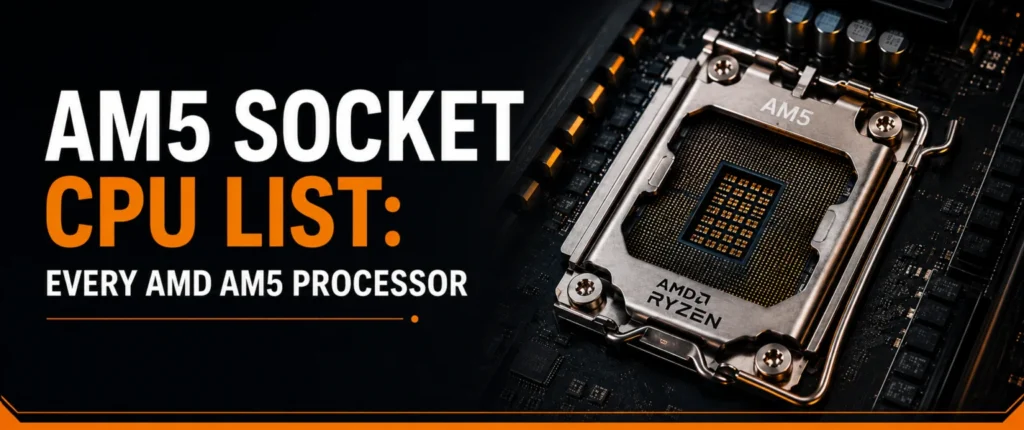
If you’re planning a new AMD build or thinking about upgrading, the first question is always the same: which chips actually work with your board? This AM5 socket CPU guide answers that in full — every Ryzen generation that fits AM5, what each one is good for, and how to match a processor with the right motherboard chipset. AMD built AM5 as the long-term replacement for the aging AM4 platform, and it brought three things AM4 never had: DDR5 memory, PCIe 5.0 lanes, and a promise of multi-year upgrade support without changing your motherboard.
This guide covers every compatible Ryzen processor on AM5, from the original 7000 series launch chips to the newest 9000X3D gaming parts, along with chipset support, integrated graphics options, and honest buying recommendations for different budgets and use cases.
What Is the AM5 Socket?
The latest mainstream desktop socket from AMD is AM5, which was released with the launch of the Ryzen 7000 series in September, 2022. It superseded the previous AM4 socket, which was used by AMD desktop processors since the 2016 generation and throughout the whole five generations. AMD needed drastic measures, since AM4 was reaching its limits of power — it was literally unable to power DDR5 memory or PCIe 5.0, the hardware of the next 10 years would rely upon.
The most apparent difference is the socket. AM4 featured a PGA (pin grid array) design with the pins recessed into the bottom of the CPU. Instead, AM5 has an LGA (land grid array) design where the pins are now on the motherboard, with flat contact pads on the processor. It’s the same thing Intel has done for years and makes it safer to handle the CPU during installation, without having to bend around exposed pins.
In addition to the physical change, AM5 boards feature up to 28 PCIe 5.0 lanes to support future GPUs and super-high-speed NVMe drives, along with native DDR5 memory (no DDR4 on the table here – plan accordingly). AMD is also promising that the socket will remain supported at least until 2027, ensuring that any motherboard purchased this year will be able to support future processors with a BIOS update.
Building a PC specifically for Rockstar’s next blockbuster? Check out our GTA 6 System Requirements guide to see which AM5 processors can deliver the best gaming experience.
Which CPUs Are Compatible with the AM5 Socket?
There isn’t any overlap between the older AM4 and newer 7000 series desktop Ryzen chip families, with all chips after the 7000 series using the new socket AM5. It is a combination of three major families: the Ryzen 7000 series chips, the Ryzen 8000G graphics-crunching APUs, and the Ryzen 9000 series Zen 5 chips, which also feature an X3D sub-series.
AM5 is only for processors from the 7000 series and newer, so no Ryzen 5000, 3000, or earlier 5000 series and 3000 series desktop processors will fit in the socket physically. The good news is that all of these chips, and of any generation, fit into any AM5 motherboard on the market, and occasionally the BIOS needs to be updated just a bit. The following section provides a breakdown per model per generation.
Complete Ryzen AM5 Compatible CPU List
This is the complete line-up of AM5 socket CPUs, arranged by generation to allow for quick, easy comparison of specs before deciding.
Ryzen 7000 Series CPUs
AM5 is the new socket that was introduced with the Ryzen 7000 family and has been designed on the Zen 4 architecture. The non-X models are the ones that are still great value for money today – and are frequently available on sale – with performance in practice that is almost indistinguishable from the X models.
| CPU | Cores / Threads | Base Clock | Boost Clock | TDP | Integrated Graphics |
|---|---|---|---|---|---|
| Ryzen 5 7500F | 6 / 12 | 3.7 GHz | 5.0 GHz | 65W | None |
| Ryzen 5 7600 | 6 / 12 | 3.8 GHz | 5.1 GHz | 65W | Radeon Graphics (2 CU) |
| Ryzen 5 7600X | 6 / 12 | 4.7 GHz | 5.3 GHz | 105W | Radeon Graphics (2 CU) |
| Ryzen 7 7700 | 8 / 16 | 3.8 GHz | 5.3 GHz | 65W | Radeon Graphics (2 CU) |
| Ryzen 7 7700X | 8 / 16 | 4.5 GHz | 5.4 GHz | 105W | Radeon Graphics (2 CU) |
| Ryzen 9 7900 | 12 / 24 | 3.7 GHz | 5.4 GHz | 65W | Radeon Graphics (2 CU) |
| Ryzen 9 7900X | 12 / 24 | 4.7 GHz | 5.6 GHz | 170W | Radeon Graphics (2 CU) |
| Ryzen 9 7950X | 16 / 32 | 4.5 GHz | 5.7 GHz | 170W | Radeon Graphics (2 CU) |
Note: every chip carrying an “F” suffix (like the 7500F) drops the integrated GPU entirely, so it needs a discrete graphics card to output a display.
Ryzen 7000X3D Series CPUs
These are AMD’s gaming specialists. Each one stacks extra L3 cache directly on top of the compute die — AMD calls this 3D V-Cache — which can lift gaming frame rates well beyond what clock speed alone would suggest.
| CPU | Cores / Threads | Base Clock | Boost Clock | TDP | Integrated Graphics |
|---|---|---|---|---|---|
| Ryzen 7 7800X3D | 8 / 16 | 4.2 GHz | 5.0 GHz | 120W | Radeon Graphics (2 CU) |
| Ryzen 9 7900X3D | 12 / 24 | 4.4 GHz | 5.6 GHz | 120W | Radeon Graphics (2 CU) |
| Ryzen 9 7950X3D | 16 / 32 | 4.2 GHz | 5.7 GHz | 120W | Radeon Graphics (2 CU) |
The 7800X3D in particular became something of a cult favorite among gaming-focused builders, since its single CCD design avoids the core-scheduling quirks that occasionally trip up the dual-chiplet 7900X3D and 7950X3D in games.
Ryzen 8000G Series APUs
The 8000G lineup swaps raw CPU muscle for a genuinely capable integrated GPU, built on RDNA 3 graphics architecture with an added AI-accelerating NPU. These are the chips to pick if you want a functional PC before you’ve saved up for a graphics card.
| CPU | Cores / Threads | Base Clock | Boost Clock | TDP | Integrated Graphics |
|---|---|---|---|---|---|
| Ryzen 5 8500G | 6 / 12 | 3.5 GHz | 5.0 GHz | 65W | Radeon 740M |
| Ryzen 5 8600G | 6 / 12 | 4.3 GHz | 5.0 GHz | 65W | Radeon 760M |
| Ryzen 7 8700G | 8 / 16 | 4.2 GHz | 5.1 GHz | 65W | Radeon 780M |
Ryzen 9000 Series CPUs
Launched in mid-2024, the Ryzen 9000 lineup moves to the Zen 5 architecture with better instructions-per-clock performance and improved efficiency over the outgoing 7000 series.
| CPU | Cores / Threads | Base Clock | Boost Clock | TDP | Integrated Graphics |
|---|---|---|---|---|---|
| Ryzen 5 9600X | 6 / 12 | 3.9 GHz | 5.4 GHz | 65W | Radeon Graphics (2 CU) |
| Ryzen 7 9700X | 8 / 16 | 3.8 GHz | 5.5 GHz | 65W | Radeon Graphics (2 CU) |
| Ryzen 9 9900X | 12 / 24 | 4.4 GHz | 5.6 GHz | 120W | Radeon Graphics (2 CU) |
| Ryzen 9 9950X | 16 / 32 | 4.3 GHz | 5.7 GHz | 170W | Radeon Graphics (2 CU) |
Ryzen 9000X3D Series CPUs
Like the 7000X3D chips, the Zen 5 3D V-Cache chips are engineered with a gaming-first approach, but this time with a second-generation cache design that AMD claims that it surpasses the 7000X3D in terms of overclocking potential.
| CPU | Cores / Threads | Base Clock | Boost Clock | TDP | Integrated Graphics |
|---|---|---|---|---|---|
| Ryzen 7 9800X3D | 8 / 16 | 4.7 GHz | 5.2 GHz | 120W | Radeon Graphics (2 CU) |
| Ryzen 9 9900X3D | 12 / 24 | 4.4 GHz | 5.5 GHz | 120W | Radeon Graphics (2 CU) |
| Ryzen 9 9950X3D | 16 / 32 | 4.3 GHz | 5.7 GHz | 170W | Radeon Graphics (2 CU) |
The 9950X3D is currently the highest on the whole AM5 socket CPU stack, featuring 16 cores and 128MB of combined cache, which is a rare 1-2 punch for gaming and multiple heavy applications in one CPU.
All AM5 CPUs with Integrated Graphics
Every AM5 processor except the ‘F’ suffix models includes integrated graphics. The “F” suffix models are the only ones that don’t have a small RDNA 2 graphics engine with 2 compute units, which is sufficient for desktop operations, video playback, and troubleshooting, but not for gaming. The 8000G is the one exception, which has a much larger RDNA 3 chip for real light games.
All CPUs with integrated graphics in the AM5 chipset have a significant difference between the two AM5 CPUs with integrated graphics. The standard 2-CU Radeon Graphics that comes with Ryzen 7000 and 9000 processors is a bit of a safety feature — you can boot a system, install the drivers, and use the fundamental productivity software until you get a discrete GPU, and even if you never want to play games. It’s not meant to be used for anything else.
The Ryzen 8000G APUs, however, are built on RDNA 3, which features many more compute units to handle popular esports games and even some AAA titles at lower resolutions without a graphics card at all. They also have an NPU (neural processing unit) for AI-related features of video calls such as background blur or noise reduction that the normal Ryzen chips do not have.
| CPU | Graphics | Compute Units | Best For |
|---|---|---|---|
| Ryzen 5/7/9 7000 (non-F) | Radeon Graphics | 2 CU | Display output only |
| Ryzen 5/7/9 9000 Series | Radeon Graphics | 2 CU | Display output only |
| Ryzen 5 8500G | Radeon 740M | 4 CU | Light gaming, HTPC |
| Ryzen 5 8600G | Radeon 760M | 8 CU | Budget gaming |
| Ryzen 7 8700G | Radeon 780M | 12 CU | Best iGPU gaming on AM5 |
If integrated graphics matter for your build — say, a budget rig, a home theater PC, or a placeholder system while GPU prices are high — the 8700G is the clear standout of the entire AM5 socket CPU family.
Best AM5 CPUs by Use Case
Picking a processor gets a lot easier once you know what you’re actually optimizing for. Here’s how the current lineup breaks down by real-world priority.
Best for Gaming
If you’re all about the frames, the Ryzen 7 9800X3D is the one to look at. It has an added advantage over the dual-chiplet X3D chips in CPU-intensive games due to its 3D V-Cache, and unlike the latter, it supports a single CCD chip to mitigate scheduling problems.
Best for Productivity
The Ryzen 9 9950X offers 16 full-speed cores for no extra cost as compared to the X3D cache variant, which makes it ideal for rendering, compiling, and heavy multi-core workloads, while it is less important for games.
Best Budget CPU
The Ryzen 5 7600 is still one of the savvy entryways to the AM5 platform. It gives up very little performance compared to the pricier 7600X, while running cooler and drawing less power.
Best Workstation CPU
The Ryzen 9 9950X3D features more cores and additional cache, making it a solid option for users who have to generate and edit video content, create 3D images, or run lengthy compile jobs.
Best CPU with Integrated Graphics
In this category, it has no peer, with the Ryzen 7 8700G taking the top spot. This RDNA 3 graphics is capable of supporting esports games without any difficulties, and with the assistance of the built-in NPU, it provides AI acceleration that no other AM5 chip so far has.
AM5 Motherboard Compatibility
One of AM5’s biggest selling points is that every motherboard chipset supports every AM5 CPU — the differences come down to features, not compatibility. That said, older boards sometimes need a BIOS update before they’ll recognize newer processors like the Ryzen 9000 series, so it’s worth checking your motherboard manufacturer’s support page before buying.
- A620 — the budget entry point. No CPU or memory overclocking, fewer PCIe lanes, but it works with every AM5 chip.
- B650 — mainstream board with PCIe 5.0 typically reserved for storage rather than the graphics slot.
- B650E — same tier as B650 but guarantees PCIe 5.0 on the graphics slot too.
- X670 — adds more connectivity and PCIe lanes via a dual-chip design, aimed at power users.
- X670E — the flagship of the original 600-series chipsets, with full PCIe 5.0 across GPU and storage.
- X870 — AMD’s refreshed 800-series board, essentially a B650E successor with mandatory USB4 and Wi-Fi 7 support.
- X870E — the current top-tier chipset, doubling USB and SATA connectivity compared to X870 and adding extra PCIe lanes for expansion.
| Chipset | PCIe 5.0 GPU Slot | USB4 | Overclocking | Best For |
|---|---|---|---|---|
| A620 | No | No | Memory only | Budget builds |
| B650 | Optional | No | Full | Mainstream |
| B650E | Guaranteed | No | Full | Mainstream gaming |
| X670 | Optional | Optional | Full | Enthusiast |
| X670E | Guaranteed | Optional | Full | High-end enthusiast |
| X870 | Guaranteed | Guaranteed | Full | Modern mainstream+ |
| X870E | Guaranteed | Guaranteed (more ports) | Full | Flagship/workstation |
Factors to Consider Before Buying an AM5 CPU
Budget: All of the items on this list should be determined by budget. Most folks will be fine with a Ryzen 5 and a B650 board, and an X870E and 9950X3D really only makes sense if you’re doing an insane amount of work that requires that much power.
Gaming: If you’re playing games, the speed and cache size of the single core is more important than the number of cores — hence the X3D chips’ dominance over gaming benchmarks, despite sometimes having fewer cores than their non-X3D counterparts.
Productivity and AI workloads, by contrast, scale much better with cores and threads, making the standard Ryzen 9 chips a much better option than the X3D chips for tasks such as rendering, compiling, or running local AI models.
When making your budget, don’t underestimate the cost and speed of DDR5 memory – AM5 relies on it, and DDR5 memory below DDR5-6000 is a missed opportunity for real performance, particularly for X3D chips. Much like that, check if you really need PCIe 5.0 support – it makes a difference only for the latest GPUs and fastest NVMe drives, but for most of today’s GPUs this is still not enough to fill even PCIe 4.0.
If you’re based on integrated graphics, the 8000G series is the only one to offer truly usable performance without a discrete card. Don’t forget cooling options either — the more powerful 240mm AIO liquid coolers are required for the high-TDP chips of the Ryzen 9 lineup, and a mid-range air cooler will work fine for the 65W chips. Lastly, before upgrading a BIOS with a newer processor, always make sure that the motherboard is compatible and that the BIOS is up to date.
AM5 vs AM4
| Feature | AM4 | AM5 |
|---|---|---|
| Memory | DDR4 | DDR5 |
| Socket Design | PGA (pins on CPU) | LGA (pins on board) |
| PCIe Support | PCIe 4.0 | PCIe 5.0 |
| CPU Compatibility | Ryzen 1000–5000 series | Ryzen 7000 series and newer |
| Upgrade Path | Ended with Ryzen 5000/5000X3D | Active, supported through 2027+ |
| Gaming Performance | Strong on X3D chips, capped by platform age | Higher ceiling with newer architecture and cache designs |
| Platform Longevity | Effectively closed | Ongoing, multi-year support committed |
There’s no need to rush an upgrade from AM4, either — the 5800X3D and other AM4 processors still offer solid gaming performance. But if you’re building fresh or your AM4 system is starting to feel dated, AM5 is the more future-proof investment, since AM4 has reached the end of its CPU release cycle.
Is AM5 Worth Buying in 2026?
Yes — AM5 is the logical option for most new construction projects for 2026 and the years to come. Intel’s frequent socket changeovers are incapable of matching AMD’s dedication to the socket, which should mean a board purchased now will be able to support CPU upgrades a couple of years from now.
The 9800X3D and 9950X3D are the new top of the range for gaming builds; with DDR5’s headroom, memory speed will continue to reap rewards for more demanding games. The
Ryzen 9 line’s high core count and quick PCIe 5.0 storage for big media files are ideal for content creation tasks. AM5’s DDR5 bandwidth and, for 8000G chips, a dedicated NPU provide an extra edge to even AI workloads.
The biggest drawback is the initial price — DDR5 and AM5 motherboards are still more expensive than AM4 ones. However, as AMD’s long-term platform support is established, it’s more of a long-term investment rather than a dead-end purchase.
Common Questions Related To AM5 CPU Socket
Do all AM5 CPUs work with all AM5 motherboards?
Yes, every AM5 CPU is electrically and physically compatible with every AM5 motherboard chipset. Older boards may need a BIOS update to support newer chips like the Ryzen 9000 series, so check your manufacturer’s compatibility list first.
Is AM5 better than AM4?
For new builds, yes. AM5 offers DDR5 memory, PCIe 5.0, and an active upgrade path, while AM4 has reached the end of its CPU release cycle and is limited to PCIe 4.0 and DDR4.
Which AM5 CPU is best for gaming?
The Ryzen 7 9800X3D currently offers the best gaming performance on AM5, thanks to its single-CCD design paired with 3D V-Cache.
What’s the fastest AM5 CPU available?
The Ryzen 9 9950X3D is the fastest all-around AM5 chip, combining 16 cores with 3D V-Cache for strong performance in both gaming and multi-threaded workloads.
What is the latest CPU for AM5?
The Ryzen 9000X3D series, including the 9800X3D, 9900X3D, and 9950X3D, represents AMD’s newest AM5 desktop processors.
Do Ryzen 9000 CPUs support AM5?
Yes, all Ryzen 9000 series CPUs use the AM5 socket and work with existing AM5 motherboards, though a BIOS update is often required on older 600-series boards.
Can I use DDR4 RAM with an AM5 motherboard?
No. AM5 exclusively supports DDR5 memory — this is a hardware limitation of the platform and cannot be changed with a BIOS update.
Conclusion
The AM5 socket CPU family now covers five processor families to provide builders with choices, depending on their needs, whether it’s budget, gaming, integrated graphics, or heavy productivity workloads. AMD’s commitment to support for PCIe 5.0 and DDR5 memory, along with the promise of further enhancements until at least 2027, has made AM5 one of the most flexible desktop platforms out there. Regardless of which processor you get (a budget model such as the Ryzen 5 7600 or the flagship 9950X3D), you’re making a long-term investment in a platform that will support you through several more chipset generations.